What Indian rummy asks you to build
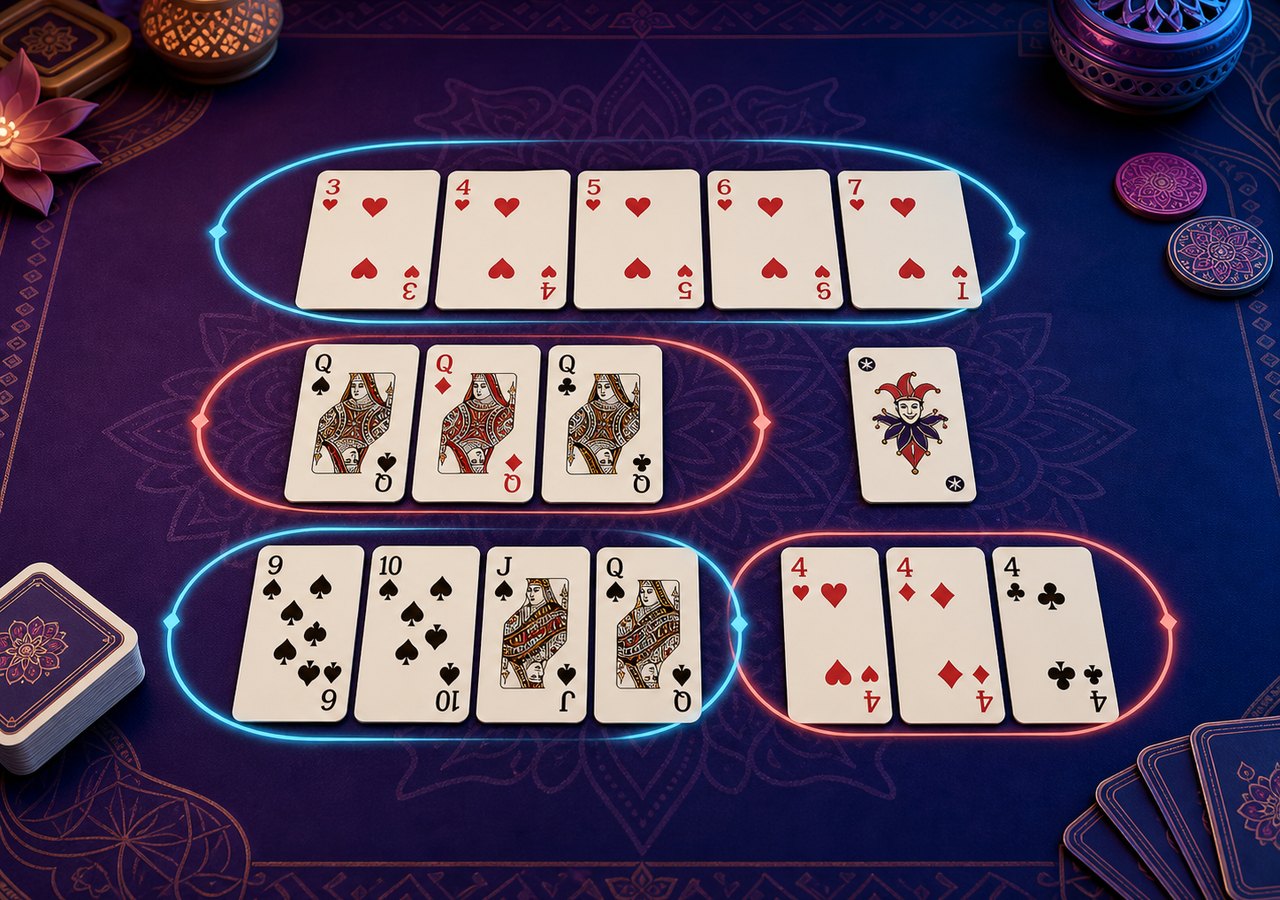
Most Indian rummy formats ask players to arrange 13 cards into valid sequences and sets. A sequence is a run of consecutive cards from the same suit. A set is a group of cards with the same rank from different suits.
Pure sequence
A pure sequence has three or more consecutive cards from one suit without using a joker as a replacement. For beginners, this should be the first goal because many invalid declarations fail at this point.
Impure sequence
An impure sequence can use a joker to replace a missing card. It is useful after you already have the required pure sequence.
Sets
A rummy set is a group of three or four cards with the same rank and different suits. For example, 7 of hearts, 7 of clubs and 7 of spades can form a three-card set. A group such as 7 of hearts, 7 of hearts and 7 of clubs is not a standard set because the same suit is repeated.
How to check whether a rummy set is valid
Check the rank first, then the suits, then any joker. All natural cards should have the same rank, while each natural card should come from a different suit. A printed or wild joker may fill a missing place when the table rules allow it, but the joker does not turn mixed ranks into a set.
- Use at least three cards unless the table rules state otherwise.
- Keep the rank the same, such as three queens or four fives.
- Use different suits for the natural cards in the group.
- Check the table's joker rule before treating a joker group as valid.
Rummy set versus sequence
A set matches cards by rank, while a sequence orders consecutive cards from one suit. Three kings from different suits can be a set; 5, 6 and 7 of hearts can be a sequence. This distinction matters because a valid hand normally needs the required pure sequence even when the remaining cards form correct sets.
Common set mistakes before declaration
The most common errors are mixing ranks, repeating a suit, using too few cards or assuming a joker removes the pure-sequence requirement. Recheck every group before declaring. You can use the free practice table to compare a set with a sequence, then review the basic grouping strategy for discard decisions.
Declaration checklist
- Find at least one pure sequence first.
- Separate remaining cards into another sequence or valid sets.
- Check joker use only after the pure sequence is safe.
- Review the platform's exact rules before joining any third-party table.
Scoring basics
Cards left unmatched can add points against the hand. Face cards and aces are usually high-value cards, so beginners often learn to reduce them early when they are not part of a useful group.